Because we rely on water, more than half of the people in the US live within 100 miles of the coast - and the shores of estuaries. Coastal communites are growing faster and faster than is countries elsewhere in the world. As more people flock to the shore, we upset the natural balance of estuaries and are threatening their health. We endanger estuaries by pollution, building on the lands surrounding them. By doing this we affect ourselves and it also leads to: beach and shellfish bed closings, harmful algae blooms, declines in fisheries, loss of habitat, and fish kills.
Friday, May 20, 2011
Estuary
Estuaries are a body of water formed where freshwater from rivers and streams flow into the ocean, mixing with the seawater. Although influenced by the tide, estuaries are protected from the full force of ocean waves, winds, and storms by the reefs, barrier islands, mud, or the sand that surround them. Making them a safe environment for creatures like: mussels, crabs, plankton, and seals. Notable examples of estuaries are: The Amazon River, Long Island Sound, and New York Harbor.
Kelp Forests

Kelp forests occur in cold, nutrient-rich water and are among the most beautiful and biologically productive habitats in the marine environment. They are found throughout the world in shallow open coastal waters, extending to both the Arctic and Antarctic Circles. Kelp forests grow remarkably fast, up to 30cm per day. The Aleutian Islands of Alaska is a notable area where there is a kelp forest. Kelp forests in the eastern and northern Pacific commonly have complex three-dimensional structure, with many coexisting species.
Foood Weeeb:
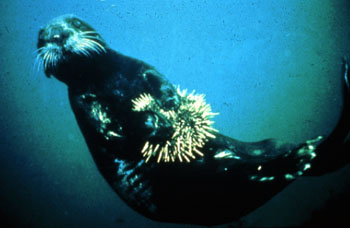
Sea otters exert strong control on kelp forest food webs. By feeding upon sea urchins, otters reduce the intensity of grazing and allow kelps to develop dense populations. Sea otters bring urchins, abalones, and other benthic animals to the surface and often smash them on their chests with the aid of a rock.
Thursday, May 19, 2011
Coral Reef
Coral reefs are warm, clear, shallow ocean habitats. The reef's massive structure is formed by coral polyps, tiny animals that live in colonies; when they die, they leave behind a hard, stony, branching structure made of limestone. There are two types of coral, hard and soft. Brain coral and elkhorn coral are examples of hard coral; sea fingers and sea whips are examples of soft coral. Soft coral is not able to build reefs. There are coral reefs off the eastern coast of Africa, off the southern coast of India, in the Red Sea, and also off the coasts of the northeast and northwest Australia. There are also coral reefs off the coast of Florida, Caribbean, and down to Brazil. The Great Barrier Reef, which is off the northeast coast of Australia, is the largest coral reef in the world. It's over 1,257 miles long.
Foood Weeeb:

3. Higher Level Heterotrophs

4. Scavengers

Many coral reefs are dying. Major threats to coral reefs are water pollution, dredging off the coast, careless collecting of coral specimens, and sedimentation.
Foood Weeeb:
1. Producers
2. Lower Level Heterotrophs
3. Higher Level Heterotrophs

4. Scavengers

Many coral reefs are dying. Major threats to coral reefs are water pollution, dredging off the coast, careless collecting of coral specimens, and sedimentation.
Woohoo!
Math. Dang this stuff is frustrating! Especially with people talking...but, I won't complain!
We calculated Species Richness and the Shannon Index on the Maryland Sea Grant Marine Education: Biofilms and Biodiversity site. You can access it at tinyurl.com/diversity33. Go into Lets Calculate Biodiversity, then, calculate the 3 species and 6 species in the examples for the Species Richness and Shannon Indexes.
After, we went outside and went to TOWN on a really awesome "Foood Weeeb."
Yes. I realize both food and web are spelled wrong. It has a purpose people.
I'll link you to my twitter account so you can follow up on the fun junk that we do!
We calculated Species Richness and the Shannon Index on the Maryland Sea Grant Marine Education: Biofilms and Biodiversity site. You can access it at tinyurl.com/diversity33. Go into Lets Calculate Biodiversity, then, calculate the 3 species and 6 species in the examples for the Species Richness and Shannon Indexes.
After, we went outside and went to TOWN on a really awesome "Foood Weeeb."
Yes. I realize both food and web are spelled wrong. It has a purpose people.
I'll link you to my twitter account so you can follow up on the fun junk that we do!
Inaugural Post
Woohoo! Today is our first day of Marine Science Intersession. So, yeah, I plan on using this blog to upload pictures, videos, slideshare links, twitter posts...you name it, it WILL be on here. Since we're going to Pigeon Key Wednesday May 25 - most of my posts will be from my twitter feed since you can't do a blog post from your iPhone.
*shakes my fist angrily*
Well, anyway. Time for the first post!
*shakes my fist angrily*
Well, anyway. Time for the first post!
Subscribe to:
Posts (Atom)